
The educational landscape has always been defined by adaptation. From the shift from parchment scrolls to printed books, and later to the advent of the internet, learning has consistently mirrored technological progress. Today, we stand at the precipice of the most profound transformation since the printing press: the integration of Artificial Intelligence (AI). AI is not merely a tool for e-learning; it is a fundamental restructuring of how knowledge is delivered, consumed, and mastered.
The traditional classroom model, designed for the industrial age, often struggled with scale and standardization. It tended to treat students as a homogenous group, applying a one-size-fits-all curriculum regardless of individual pace, learning style, or unique intellectual strengths. However, the digital age, powered by AI, is finally enabling the realization of the long-sought educational ideal: truly personalized, adaptive, and globally accessible learning.
This revolution promises to shift the focus from information delivery to skill cultivation. AI promises to unlock student potential by making education more equitable, more efficient, and deeply tailored to the needs of the 21st-century learner. But what does this revolution look like in practice? How are these technologies changing student success, and what challenges must we navigate to ensure this promise is realized for all?
The Era of Hyper-Personalization: AI as the Ultimate Tutor
Perhaps the most revolutionary aspect of AI in education is its ability to move beyond standardized testing and embrace hyper-personalization. No two students learn the same way, and no two learning journeys are identical. A student might grasp complex physics concepts visually but struggle with abstract textual explanations. Another might excel in rapid recall but falter when applying knowledge in novel scenarios.
Traditional educational systems often struggle to identify these nuances in real-time. AI changes this by acting as an infinitely patient, omniscient tutor. AI-powered learning platforms analyze massive datasets of student interactions—how long a student pauses on a concept, which types of examples they request, which practice problems they struggle with—and instantly adjust the curriculum.
This adaptive learning process means that if a student masters a module quickly, the system doesn’t make them wait; it accelerates them to the next challenge. Conversely, if a student encounters a difficult concept, the AI doesn’t just mark the answer wrong; it diagnoses the root cause of the misunderstanding. It might realize the student is struggling with basic algebra concepts that underpin the current calculus lesson, and it will automatically generate remedial micro-lessons until the foundational gap is filled.
This level of granular feedback is invaluable. It transforms the learning experience from a passive reception of lectures into an active, responsive dialogue between the student and the technology. The goal is not just to pass an exam, but to build deep, durable understanding—the kind that lasts a lifetime.
AI-Driven Content Creation and Accessibility
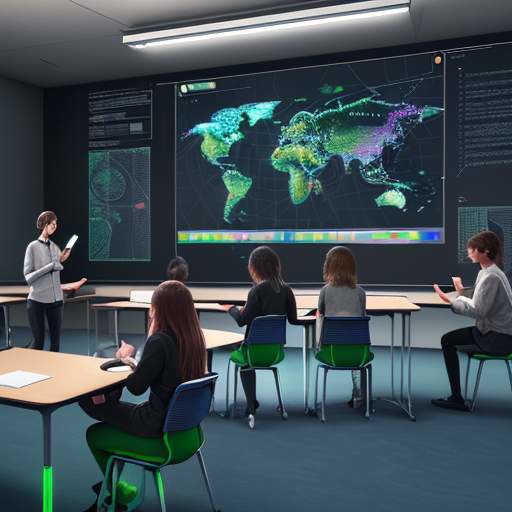
Historically, the cost and availability of high-quality educational content have been massive barriers to global learning. Expert professors, advanced lab equipment, and specialized curricula were often confined to wealthy, urban centers. AI is dismantling these geographical and economic barriers through sophisticated content generation and localization.
AI models can now take a core academic concept—say, the principles of quantum mechanics—and instantly generate multiple learning formats: a detailed animated video, a simplified infographic, a complex interactive simulation, and a graded quiz, all tailored for different age groups and cultural backgrounds.
Furthermore, accessibility is dramatically enhanced. AI-powered tools can automatically translate complex academic texts into dozens of languages while simultaneously adjusting the reading level, providing visual descriptions for the visually impaired, or generating sign language avatars for the hearing impaired. This democratization of knowledge means that a student in a remote village can access the same quality of specialized instruction as a student at an Ivy League university.
This shift moves education from being a resource-constrained commodity to a universally available utility. It ensures that the brilliance of human knowledge can finally reach every corner of the globe, fostering unprecedented global equity in opportunity.
The Role of AI in Assessment and Feedback
One of the most persistent criticisms of traditional education is the assessment process. Grades often feel reductive—a single number that fails to capture the complexity of a student’s growth, effort, or unique insights. Grading is time-consuming, subjective, and often lags behind the actual learning event.
AI fundamentally changes this by shifting assessment from summative (testing what you know at the end) to formative (guiding you as you learn).
AI assessment tools can analyze open-ended assignments, essays, and even complex problem-solving processes. They don’t just check for correct keywords; they evaluate the structure of the argument, the sophistication of the reasoning, and the clarity of the communication. For instance, if a student writes an essay, the AI can highlight not just grammatical errors, but instances where the logical flow breaks down or where the thesis statement lacks sufficient evidence, providing immediate, actionable feedback that a human grader might miss due to sheer volume.
Moreover, AI can identify patterns of academic dishonesty with unprecedented accuracy, while also providing students with detailed "skill heatmaps"—visual representations showing exactly which skills (e.g., critical thinking, persuasive writing, data visualization) they need to improve, rather than just a general grade. This level of diagnostic precision empowers students to take ownership of their educational journey.
AI and the Future of the Educator
A common fear surrounding AI integration is that it will replace human teachers. This perspective is fundamentally flawed. Instead, AI is poised to elevate and redefine the role of the educator.
If AI handles the mechanical, repetitive, and diagnostic tasks—such as grading quizzes, identifying knowledge gaps, and generating foundational content—it frees up the human teacher to do what technology cannot replicate: mentorship, emotional guidance, and fostering creativity.
The teacher evolves from being a content dispenser to being a curator, coach, and catalyst. Their time is spent facilitating deep discussions, leading ethical debates, nurturing emotional intelligence, and helping students connect abstract knowledge to real-world impact. The human element—the empathy, the inspiration, the ability to spark genuine curiosity—remains irreplaceable.
The partnership between AI and the teacher is symbiotic. AI provides the data and the efficiency; the human teacher provides the wisdom, the moral compass, and the necessary human touch. This collaboration ensures that technology serves the deeply human goal of intellectual flourishing.

Addressing the Ethical and Equity Challenges
The power of AI in education is immense, but with great power comes great responsibility. For the revolution to succeed, we must proactively address several critical challenges.
The most immediate concern is the issue of digital equity. If advanced AI learning tools are only accessible to wealthy institutions or students in developed nations, the existing educational gap will widen into an insurmountable chasm. Ensuring that the infrastructure, devices, and high-speed internet required for AI learning are available globally is paramount.
Another challenge is data privacy and algorithmic bias. AI systems are only as good as the data they are trained on. If the training data reflects historical biases—such as gender bias in career recommendations or racial bias in disciplinary tracking—the AI will not only perpetuate but amplify those biases. Robust ethical guidelines, transparent data usage policies, and diverse data sets are non-negotiable requirements for responsible AI deployment.
Finally, there is the challenge of human skill development. As AI takes over routine cognitive tasks, education must pivot to teach uniquely human skills: emotional intelligence, complex ethical reasoning, creative problem-solving, and adaptability. The curriculum must evolve from teaching what to think, to teaching how to think critically in an AI-augmented world.
Conclusion: Learning for a Connected Future
The AI revolution in education is not a futuristic concept; it is a rapidly unfolding reality. It promises to dismantle the limitations of the industrial-age classroom, offering a pathway to learning that is deeply personalized, universally accessible, and constantly adaptive.
For students, this means a path to success that is guided by data, nurtured by technology, and supported by a re-imagined relationship with the human teacher. For institutions, it means a mandate to become agile, data-driven, and ethically responsible.
The shift requires more than just adopting new software; it requires a fundamental philosophical change in how we define "learning" and "success." Success in the AI era will not be defined by the accumulation of facts, but by the mastery of adaptability, critical thinking, and the ability to collaborate—both with fellow humans and with intelligent machines.
By embracing AI responsibly, prioritizing equity, and keeping the human element at the core of the process, we can ensure that e-learning truly becomes the engine for a globally connected, highly skilled, and profoundly successful future. The classroom of tomorrow is not just digital; it is intelligent.



















Recent Comments